
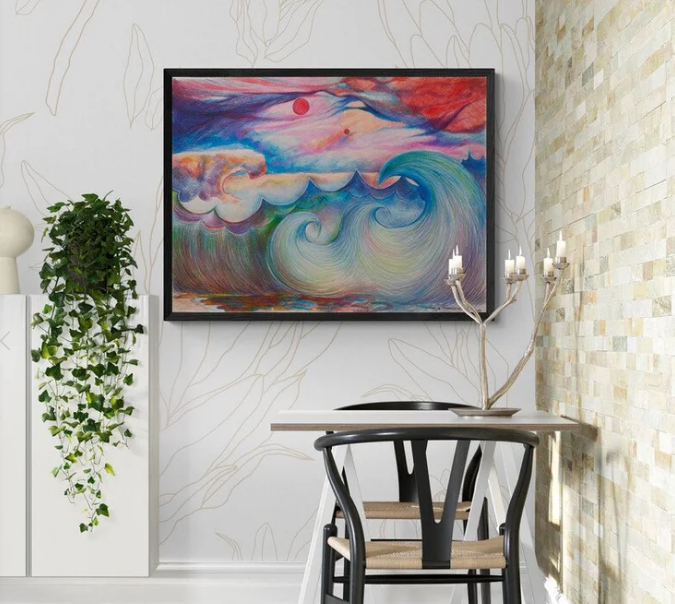
We are living in a time where the traditional separation between a laboratory and an art studio no longer exists. You might think that science is only about numbers and art is only about feelings, but art and quantum physics actually use the same language to explain the universe. When you look at a painting or a sculpture, you are looking at a physical representation of how energy moves, how particles behave, and how the very fabric of our reality is constructed.
This connection is not just for scholars or professional critics; it is something you can bring into your own home to change how you feel and think. Many people today choose to buy original art online because they want their living spaces to reflect the cutting-edge theories of our modern age. By surrounding yourself with work that mirrors the subatomic world, you are creating an environment that is both intellectually stimulating and visually striking.
The Role of Art in Your Remote Work Environment
If you work from home, you know how difficult it can be to stay focused for eight hours a day in the same room. Your brain needs more than just a desk and a computer to function at its best. Scientific research shows that having visual art in your office has a direct impact on your cognitive performance and your mental health.
When you look at a piece of art, your brain releases dopamine, which is the chemical responsible for feelings of pleasure and motivation. This is especially helpful during a long workday when you might feel your energy starting to drop. Instead of staring at a blank wall or a digital screen, looking at a physical piece of art gives your eyes a "micro-break." This reduces eye strain and resets your mental focus, allowing you to return to your tasks with a fresh perspective.
Art also acts as a silent partner in your creative process. Even if your job is not in a creative field, you still need to solve problems and think of new ways to handle challenges. The presence of abstract or science-inspired art encourages your brain to think outside of linear patterns. It activates parts of your brain that are responsible for "big picture" thinking, helping you see solutions that you might have missed in a sterile, undecorated environment.
Understanding Superposition Through Visual Layers
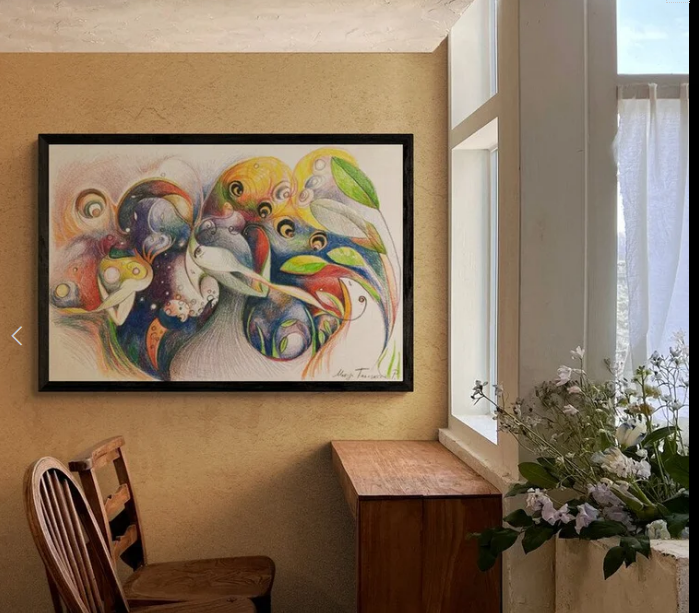
In quantum physics, the concept of superposition suggests that a particle exists in multiple states or locations at the exact same time until it is observed. This is a very difficult thing for the human mind to grasp because we are used to objects being solid and singular. However, artists use layers of paint and light to show you exactly what this looks like.
When you see a painting with thirty or forty layers of translucent glazes, you are seeing a visual representation of superposition. Each layer is a different possibility or a different state of the subject. Because the paint is thin, light can travel through all those layers and bounce back to your eyes, making the image feel like it is shifting. This mirrors the subatomic reality where things are not fixed until we choose to measure them.
This type of art is perfect for a home office because it reminds you that there are always multiple ways to look at a problem. It trains your brain to accept complexity and to look beneath the surface. By choosing to buy original artwork online that features these deep, layered textures, you are adding a sophisticated level of depth to your daily surroundings.
The Science of Color and Work Productivity
The colors you choose for your workspace are not just about fashion; they are about biology. Different colors move at different frequencies, and these frequencies have a physical effect on your heart rate and your brain waves. If you want to stay calm during high-stress meetings, you should look for art that uses cool tones like blue and green.
Blue is known to lower blood pressure and slow down your breathing, which is why it is the most popular color for productive work environments. It helps you stay "in the zone" for longer periods. On the other hand, if your work requires a lot of high-energy brainstorming, you might want a piece with splashes of orange or yellow. These warm colors stimulate the nervous system and give you a boost of energy.
Science-inspired artists often select their pigments based on these natural frequencies. They might use pure mineral pigments that reflect light more accurately than synthetic paints. This makes the color "vibrate" in a way that feels more natural and less tiring for your eyes. This is why a hand-painted piece often feels much better to look at than a digital print on a screen; the physical minerals are interacting with the light in your room in a way that a pixel cannot.
Entanglement: The Invisible Connections in Your Office
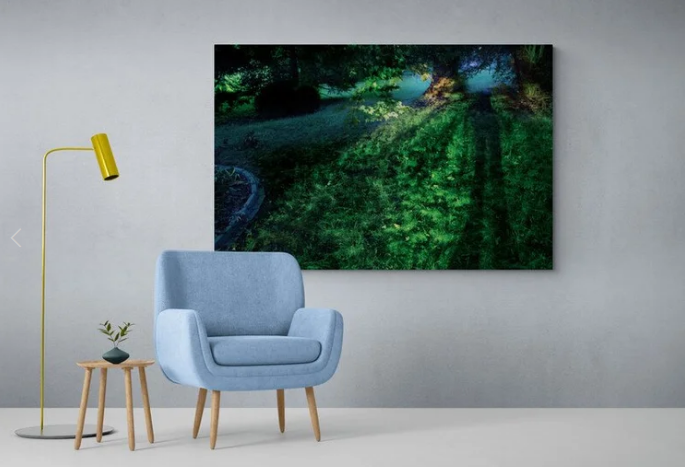
Quantum entanglement is the idea that two particles can be connected so that what happens to one affects the other instantly, even if they are miles apart. In your office, you can use art to represent this sense of connection and order. Many contemporary artists create "diptychs" or "triptychs," which are sets of two or three paintings designed to hang together.
This scientific concept leads to a significant question known as the observer effect. In physics, the act of observing a wave actually changes it into a solid particle. Your mind, with its own information field, is the force behind this change. Art helps resolve this scientific dilemma by showing how our thoughts and observations influence the reality we see. When you look at a piece of art, your mind is participating in the creation of that reality.
Even though the canvases are separate, the pattern flows from one to the next, creating an invisible link. This creates a sense of harmony and balance in a room. When you see these connections, it helps your brain feel more organized and less scattered. It is a visual reminder that your work, your life, and the universe are all part of a single, interconnected system.
This concept is also found in sculpture. A tabletop piece might consist of two parts that fit together like a puzzle. Having a physical object like this on your desk gives you something tactile to touch during phone calls or while you are thinking. This "grounding" activity helps reduce anxiety and keeps you present in the moment, which is a major benefit for anyone working in a remote setting.
The Uncertainty Principle and Creative Freedom
Werner Heisenberg’s Uncertainty Principle states that we cannot know everything about a particle at once; the more we focus on one detail, the more another detail becomes a blur. This has changed the way modern artists approach their work. Instead of trying to make a "perfect" or "realistic" image, they embrace the blur and the unfinished edge.
This is a very important lesson for your work life. Often, we get stuck trying to make every detail of a project perfect, which stops us from making progress. Having art that celebrates uncertainty tells your brain that it is okay to have "rough edges" as you work toward a final goal. It encourages a "growth mindset" where the process is just as important as the result.
When you look at a piece of art that is abstract or partially unformed, your brain has to work to complete the image. This is a form of mental exercise that keeps your cognitive functions sharp. It prevents your mind from becoming "lazy" in a repetitive work routine. By inviting uncertainty into your office through art, you are actually making yourself a more flexible and resilient worker.
Mapping Energy and Motion on Your Walls
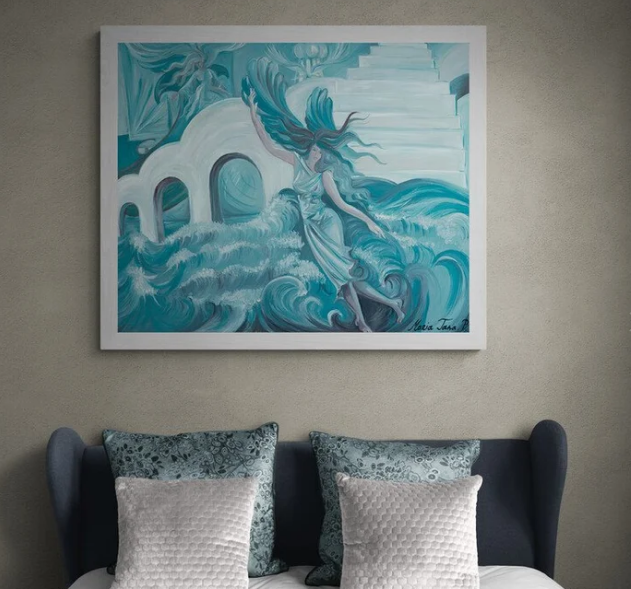
Scientists use bubble chambers and particle accelerators to track the paths of energy. These paths often look like beautiful, sweeping curves and spirals. Artists take these scientific maps and use them to create compositions that feel full of life and motion. These are often called "vector lines" or "trajectories."
When you have a painting with these strong, directional lines in your office, it creates a sense of momentum. It feels like the room is moving forward, which can help you get through a heavy workload. These lines act as a guide for your eyes, leading them across the canvas in a rhythmic way that is very soothing for the brain.
This type of art is a great alternative to traditional landscapes. While a picture of a forest might be relaxing, a picture of "energy in motion" is both relaxing and stimulating. It reflects the fast-paced nature of the modern world while providing the visual order that the human mind craves. This balance is what makes contemporary science-based art such a powerful tool for interior design.
The Physics of Texture and Tactile Art
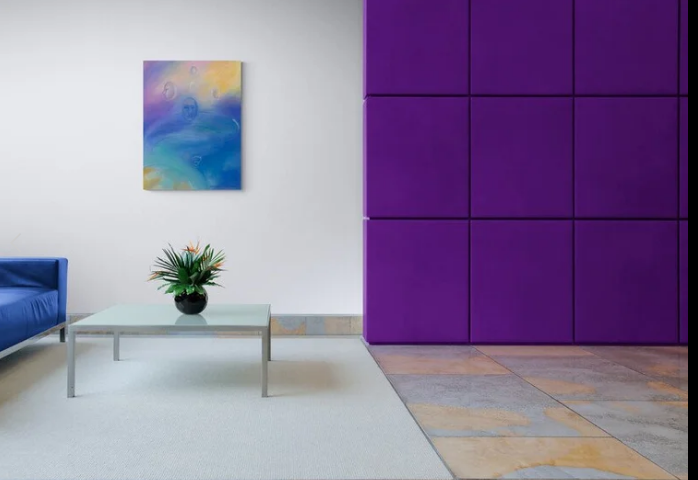
We spend most of our workdays touching flat glass screens and plastic keyboards. This lack of tactile variety can lead to a feeling of being "disconnected" from the real world. This is why having art with physical texture, such as a terracotta sculpture or a thick oil painting, is so important for your mental health.
The way light hits the "peaks and valleys" of a textured painting creates a sense of reality that a flat print cannot match. It reminds you that you are in a physical space, not just a digital one. This is especially true for sculptures made of clay or wood. These materials have a "natural frequency" that our bodies respond to on a subconscious level.
If you have a small sculpture on your desk, you can pick it up and feel its weight and temperature. This simple act can lower your cortisol levels (the stress hormone) and help you feel more relaxed. It is a way to "re-center" yourself during a busy day. Choosing to buy contemporary clay sculptures is a practical investment in your own daily comfort and well-being.
Why Original Art Matters More Than Mass-Produced Decor
You might be tempted to just buy a cheap poster from a big-box store, but there is a significant difference in how your brain reacts to an original piece of art. An original work carries the "energy" of the artist's decisions. Every brushstroke and every thumbprint on a clay piece represents a moment of human thought and problem-solving.
Mass-produced items are made by machines and lack this human element. Your brain can tell the difference. When you look at an original piece, you are engaging in a silent conversation with the creator. This is why original art is much better at sparking new ideas and keeping you engaged with your surroundings.
The Influence of Marija Tanaskovic Papadopoulos
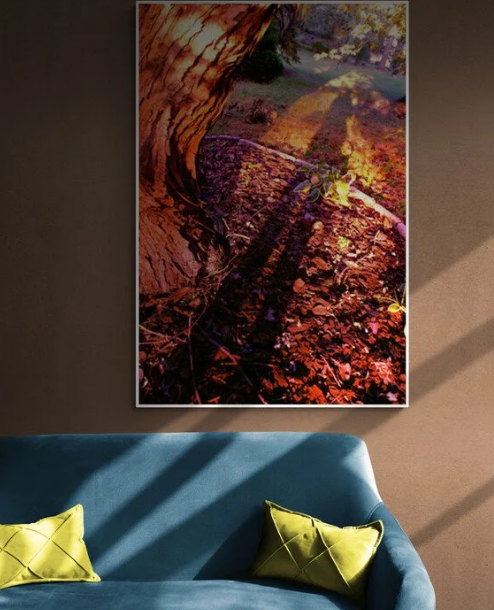
In the world of science-inspired art, Marija Tanaskovic Papadopoulos is a leading name. Based in Chicago, she has built a career on merging the old-world skill of sculpting with the high-tech world of 3D digital design. Her work is featured in international encyclopedias because it successfully bridges the gap between what we know through math and what we feel through art.
She uses programs like ZBrush to create complex models of scientific theories, then turns them into physical objects that you can place in your home. This process is a mirror of the scientific method itself: you start with a hypothesis (the digital model), and you work toward a physical result (the finished art). Her ability to move between these two worlds makes her work a perfect fit for a modern, tech-driven office.
By following her philosophy, you can see how art is not just a luxury; it is a way to stay connected to the biggest ideas of our time. Whether she is working in oil, clay, or digital pixels, her goal is to pass energy and inspiration to the viewer. This is exactly what you need in a workspace—a constant source of energy that keeps you moving forward.
High-Resolution Prints and the Modern Office
If you do not have the space for a large original painting, high-quality contemporary fine art prints are an excellent alternative. Modern printing technology, like Giclee on metal or canvas, allows for a level of detail that was impossible twenty years ago. These prints can capture the exact color wavelengths of the original piece, ensuring you still get the biological benefits of the art.
Metal prints, in particular, have a very modern and sleek look that fits well in a tech-focused office. They are durable, easy to clean, and they reflect light in a way that makes the colors pop. This adds a sense of "brightness" to a room, which can improve your mood and make the space feel larger.
The Psychology of Geometric vs. Organic Shapes
When you are choosing art for your office, you should consider the difference between geometric and organic shapes. Geometric art, which uses straight lines and perfect circles, creates a sense of order, logic, and precision. This is very helpful if your work involves a lot of data, math, or organization. It helps keep your thoughts structured and clear.
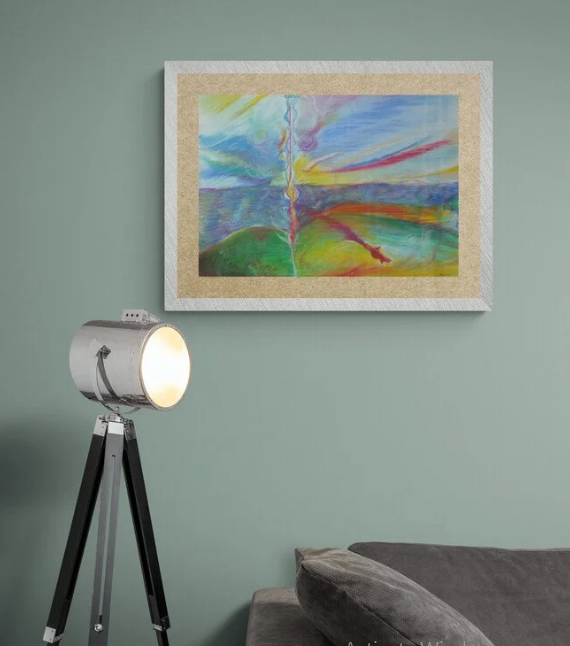
Organic art, on the other hand, uses fluid, flowing lines that look like things found in nature. This type of art is better for relaxation and creative thinking. It encourages a "soft" focus that allows your mind to wander and come up with new ideas. Many people find that a mix of both is the best way to keep their office balanced.
A science-inspired piece often combines these two styles. It might show a precise geometric grid that is being "broken" by a fluid wave of energy. This represents the way the universe works: there are strict laws of physics, but within those laws, there is a lot of freedom and chaos. Having this balance on your wall helps you stay both organized and creative throughout the workday.
A Smarter Way to Decorate
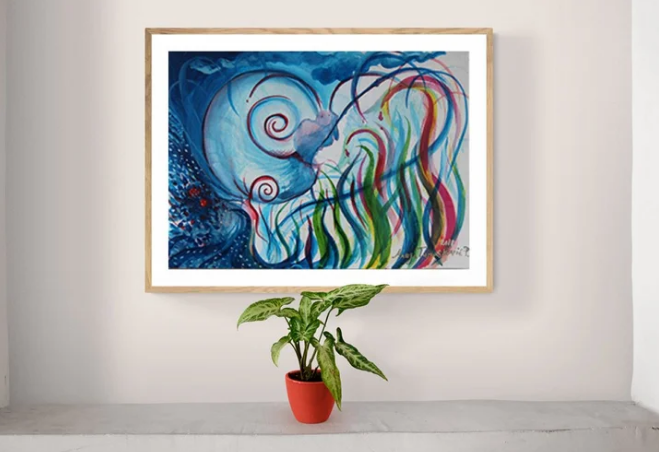
As you've seen, the connection between contemporary art and science is more than just a visual trend. It's a way for you to align your daily environment with the fundamental laws of the universe. By selecting work that represents concepts like superposition or entanglement, you're not just buying a decoration; you're buying a mental tool. Whether you decide to buy art prints online or find original contemporary art for sale, you're making a commitment to a higher level of living and working.
Choosing to buy original art from artists who understand these scientific principles ensures that your home office remains a place of deep meaning and high productivity. If you're looking for a piece that captures this unique energy, we invite you to see the current offerings by Marija Tanaskovic Papadopoulos at Maria Tana Designs and Art. Each creation is a bridge between the physical and the digital, designed to bring the wonder of modern physics into your personal world and elevate your daily work experience.
Contact us to find out more.
About the Author
Julian Thorne is a technical writer and design consultant specializing in the intersection of cognitive psychology and modern workspaces. With a background in environmental aesthetics, we focus on how visual stimuli influence professional output. Julian collaborates with brands like Maria Tana Designs and Art to highlight the functional benefits of science-based decor.