
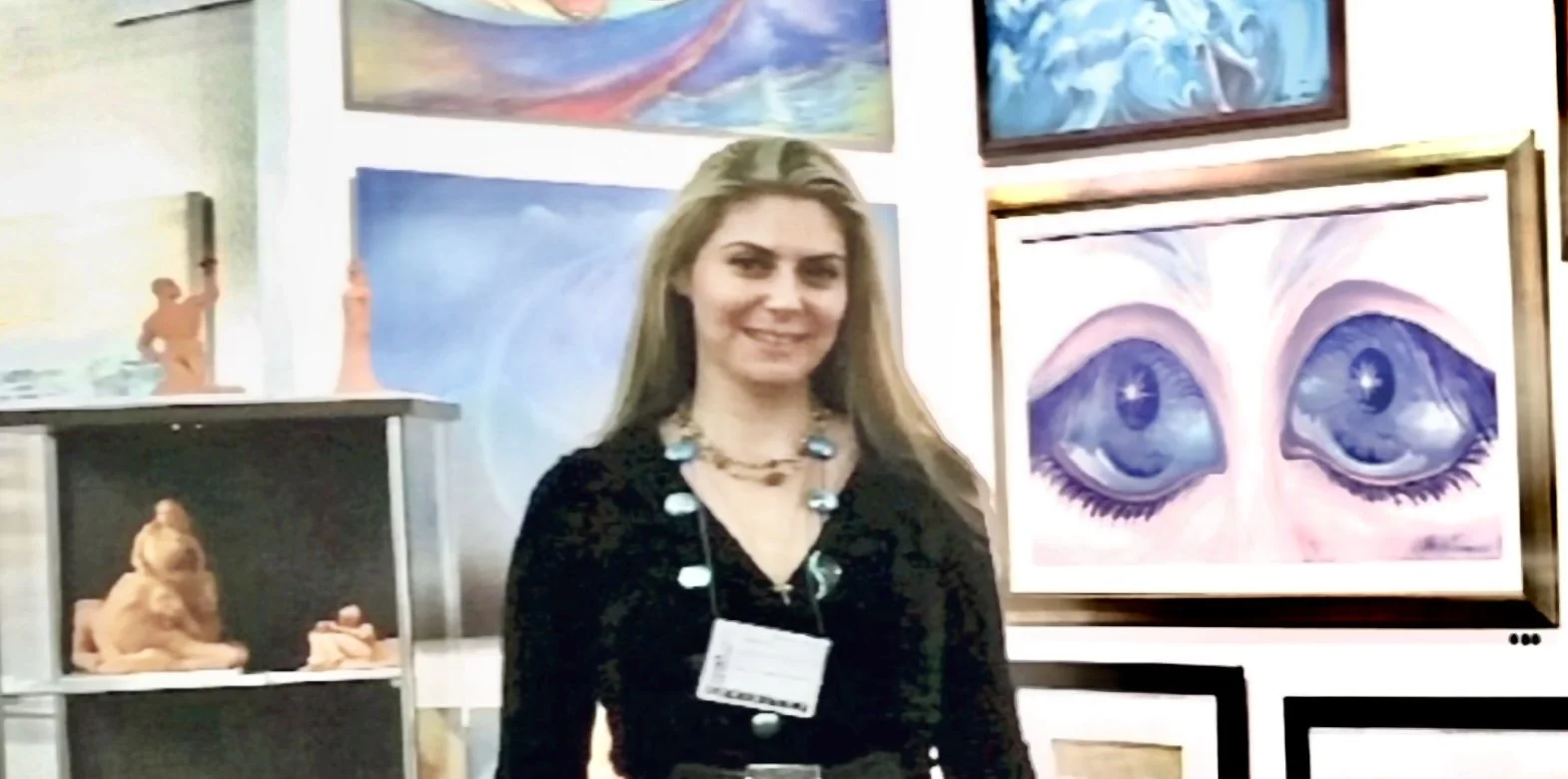
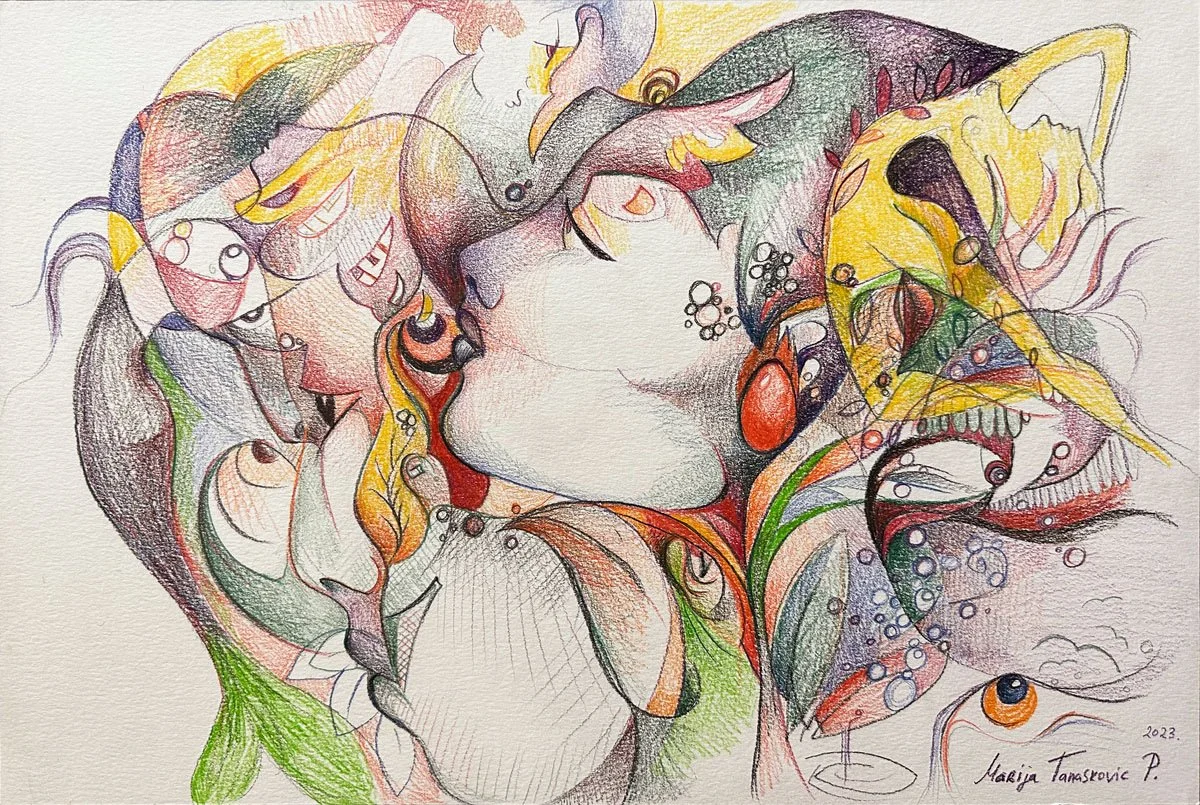
Inside the Cleverness of a Bee , author , Marija Tanaskovic Papadopoulos, 2024.

Source of the article below is bcs.mit.edu . Other sources used are from the articles and interviews about artist.
“Visual Art is all about passing energy to other people through the symbols and vibration of lines, color wavelengths, and shapes of artwork in the space that surrounds it, while the meaning of the artwork is not only what composition actually presents, but a specific structure of that art piece, that makes a human being able to notice a beauty as a source of harmony. “
— Artist Statement by Marija Tanaskovic Papadopoulos (2006)
The following text is an explanation of Marija’s Artist Statement, made by her in 2006, that matched the scientific findings about Cognition and Conciseness in 2026.
At that time she had to further explain it, because the curators showed interest in her art and they needed every detail explained clearly in order to place here in the line of serious artcreators.
As a master of fact , it was understandable that it wasn’t t clear to them what does the vibration of the artwork do and where it is hidden inside the art piece. They needed to know more in order to accept her work in the line of the new art leaders of do to the originality of the style that was still rooted in traditional approaches.
They need to know what was causing the vibration in our environment so that we can feel them related to the art piece?
Today’s success and recognition by international critics was directly related to her explanation. Therefore her idea had to be presented correctly.
The subject of one artist statement is the reason behind she why she as an artist created and what here art represents.
She explained that the reason is not a subject or a theme or a story she is following but the rules and codes of the composition itself. She explained that artwork is a trigger while observer with his brainwaves is the one who completes the artwork in our reality. That means that audience is continually creating the artwork while artist is navigator if their thoughts by artwork structure.
So her art represents a visual ad to move the audience’s feelings and thoughts by the way composition is created.
As a master of fact, she was required to explain further her thoughts about how she understands the process of creation to the curators, which was part of the her professional affirmation in contemporary art field.
What she verbalized then was a very advanced way of understanding the brain function through the lense of quantum physics.
She was raising eyebrows because she said it in her own words as an Artist, which awaken the curiosity in this field among other artists and scholars in following years.
The interest in this subject have increased severely recently because they did not get her serious until now. In a more ment when she came up with this explanation her point of view twenty years ago was not supported anywhere except by her own convictions that what was she saying is correct.
Today we can see that she left the pathway twenty years for scientific discovery about the Consciousness in the field of Quantum Physics and Cognitive Science.
As a matter of fact , she was right about brain waves interference and their role in creating our reality 20 years ago. The reality is what we are aware of, and therefore in some way the reality is a product of our consciousness.
This was her actual explanation of the artist statement :
Additional conclusion and explanation about the Contemporary artist statement :
(beginning of quote)
“Today’s achievements in modern medicine, chemistry, and psychology, can include contemporary visual art as one of the sources for decoding the cure for many different diseases and much more than that.
As a matter of fact, Quantum physics defines the particle as the universal starting point for philosophical and mathematical analysis, is holding the “observer” as a vehicle of electromagnetic waves that is caring electrons of energy dispersed in a logical order, as the light we see.
As a matter of fact, the order of electrons is, also, scientifically proven and known today as the “wave interference.”That means that every single “thought” is made out of electromagnetic waves, which are rated through the observer’s brain as a specific structure that has a specific vibration and radiation. Our brain is a mechanism to notice, decide and influence the surroundings in a way that we can discover, by ourselves, by our own experience.
However, the electrons that surround us can multiply thanks to the brain waves because they are electro-magnetic in their nature, but they are created by our brain, which are triggering a new wave interference every time we observe something. It is Logical that the reach of the “waves” presented through the “interference pattern”, is increasing through time.This means that thoughts can spread within and over the bounders of our life, and have a crucial influence everywhere by their radiation.
Having beautiful and peaceful thoughts means deserving and getting the best in life.
The knowledge can help to achieve that state of mind.
So, Art could be understood as the knowledge stored for new science turnaround towards the new energy, which exists within us, and it could be, also, triggered by some visual ads if they would carry the powerful “aesthetic code”.
Today it is known that the human brain is using less than 10 % of its capacity and nothing more than that has been scientifically proven yet. However, by exploring art, we could move our understanding of the way we are living today because Art was always opening new doors of our psyche that we never even knew, existed…”
— Marija Tanaskovic Papadopoulos 2006
(end of quote)
The following article was sent in full to be on the same page the information that will put light on this subject and resonate this information with paragraphs we made bold intentionally, to describe the parallels between two conclusions that are very similar.
The mentioned above was given by an Artist, while the following article was explanation given by the cognitive scientists twenty years later:
This is the link
Researchers suggest that the processes involved in cognition and consciousness arise from the analog processing enabled by brain waves that move at various frequencies.
A recent theory introduced in The Journal of Neuroscience by three researchers from MIT’s Picower Institute for Learning and Memory clarifies how the brain might produce cognition and consciousness. It proposes that rhythmic neural activity generates traveling waves to organize flexible networks of neurons during analog computations.
Picower Professor Earl K. Miller, the lead author of the paper, states that the notion of the brain functioning through “circuits” only partially represents its complexity.
The circuits physically connect to support memory storage and express our current needs and goals. However, when we need to access this knowledge quickly amid rapidly changing sensory inputs, relying solely on synapses—the connections between circuits that undergo a slow chemical rewiring process—is inadequate, he explains.
The brain requires a control system that synchronizes millions of neurons to process information almost instantaneously. Miller and his team argue that brain waves—synchronized and rhythmic variations across large groups of neurons—fulfill this crucial function, citing extensive experimental evidence from their lab and others.
“Circuits and synapses are important and fundamental—that’s where we start. But there’s more happening,” Miller, who teaches in MIT’s Department of Brain and Cognitive Sciences, asserts. “The brain produces waves, and the dynamics of these waves provide an effective method to synchronize activity and perform computations.”
Digital circuits execute calculations sequentially with switches and gates. In contrast, analog computation, facilitated by wave interference, can execute multiple calculations simultaneously. This method proves to be not only more effective but also reflective of the brain’s widespread use of locally focused traveling waves, the scientists emphasize.
“The brain utilizes its own physics," noted Miller along with his colleagues, Scott L. Brincat and Jefferson E. Roy, who research in Miller's lab.
This new theory is significant not only for explaining cognition and consciousness but also for highlighting the potential benefits of incorporating waves in clinical treatments. Notably, it is possible to manipulate waves without invasive methods.
“Miller believes that creating treatments based on brain-wave dynamics represents not just an opportunity but a responsibility,” as his lab participates in a joint effort exploring brain waves in autism.
Building the analog argument
To support the idea that the brain employs waves to coordinate neurons in ways that aid cognition and consciousness, the researchers begin with a well-known discovery: numerous neurons fulfill multiple functions. They react to various cues and contexts, participating in several functional networks simultaneously. This phenomenon is termed “mixed selectivity.” Miller and his team have long maintained that it equips the brain with remarkable computational capabilities. However, it also raises an important question: How does the brain swiftly and flexibly arrange these overlapping networks to facilitate the agile thinking we depend on?
After extensive studies, Miller and other neuroscientists view brain waves as the solution: they organize neuron groups for information processing. Miller has demonstrated that waves of differing frequencies govern cognitive activities like working memory and predictive coding. The slower “alpha” and “beta” waves, which signify memories and goals, oversee the quicker “gamma” waves, linked to incoming sensory information.
The new theory suggests that alpha/beta control waves stem from synchronized neuron firing in circuits—networks linked at points known as “synapses”—which encode memories and goals. “Synapses retain representations, while wave dynamics help decide which representations remain active at any moment,” the authors stated.
In recent research, the Miller lab discovered that although these waves originate from neural spiking, they can rapidly strengthen to directly influence and coordinate spiking via a process called ephaptic coupling, which is mediated by electric fields. Notably, electric fields coordinate activity at a high speed.
Another crucial aspect of the theory, confirmed through experiments by Miller’s lab, is that alpha/beta waves control activity both spatially, by impacting localized areas of the cortex, and temporally, by moving across the cortex. Essentially, beta waves serve as mobile stencils, directing when and where gamma waves process sensory information and which neuron groups participate. Collectively, these results imply that the brain engages in "spatiotemporal computing," according to the authors. Where the waves overlap, they can add or subtract, facilitating analog computations.
Miller points out that the next goal for his lab is to gather direct evidence demonstrating that analog computations occur. “This is a theory. We aim to test it by searching for signatures of analog computation in brain wave patterns,” Miller explains.
Connection to consciousness
The article suggests that consciousness “emerges when these dynamic wave patterns bring the cortex into an organized, globally integrated state, one that naturally links and influences widespread activity.”
Some of the strongest evidence linking wave dynamics with consciousness stems from studies on general anesthesia conducted by Miller and his Picower Institute colleague Emery N. Brown.Brown serves as an Institute professor at MIT, anesthesiologist at Massachusetts General Hospital, and professor at Harvard Medical School. Their labs found that three drugs, each engaging distinct molecular mechanisms, similarly disrupt brain wave dynamics and induce unconsciousness.
“Consciousness depends less on specific receptors or cell types and more on the integrity of large-scale wave organization,” the authors state in their review.
In other words, consciousness, like cognition, depends on the brain’s capacity to organize itself effectively through brain waves.
“Electric field dynamics provide a low-overhead method for organizing and coordinating information in cortical networks,” they conclude. “Considering the strong evolutionary pressure to optimize computation for each unit of energy, it would be unexpected if evolution did not utilize such a built-in analog computing method.”
The Freedom Together Foundation, The Picower Institute for Learning and Memory, the U.S. Army Research Office, the U.S. Office of Naval Research, a MURI grant, the National Institutes of Health, and the Simons Center for the Social Brain funded the research.