mesurment problem

Contemporary Artist Bridges Quantum Physics and Visual Art Through Revolutionary Creative Philosophy

Source Insider Weekly

The convergence of art and science has taken an unforeseen direction through the innovative work of internationally recognized artist Marija Tanaskovic Papadopoulos. Her distinctive method of visual creation is deeply rooted in the principles of quantum mechanics and modern physics. This groundbreaking approach has garnered the interest of art market specialists and curators around the globe, positioning her as one of the most sought-after contemporary artists today.

The accolades she has received are impressive. In 2025, Art Celebrity magazine devoted an entire issue to Tanaskovic Papadopoulos’s artistry, while in 2024, Celebrity Masters recognized her as a Top Artist figure in contemporary art. Her list of honors includes esteemed awards such as the Leonardo Da Vinci Award, the Michelangelo Award, and the Franco Di Assisi Award for human rights, among others. Additionally, Marquis Who’s Who in America has included her in their most recent edition, solidifying her reputation within the global art community.

What distinguishes this artist is her scientific method of comprehending how art operates within human consciousness. By referencing the renowned double-slit experiment in quantum physics, she delves into how the mere act of observation alters reality. In the realm of quantum mechanics, observation leads to the collapse of wave functions into particles, fundamentally changing the state of matter at the subatomic level.

The scientific conundrum known as the measurement problem pertains to the observation phenomenon during the double-slit experiment. Science has yet to definitively ascertain whether it is solely the measurement instrument or if the observer's mind also plays a role in collapsing the wave function into a particle. Nevertheless, this is the focal point of Tanaskovic Papadopoulos's attention as she applies this principle to visual art, suggesting that viewers do not merely passively observe artwork but actively engage in shaping its meaning and impact.

Marija recognizes that establishing a connection between the quantum level of particles and the macro level of our world is unattainable within the conventional scientific framework due to the fundamentally different laws of physics governing each. This is precisely why bridging the two realms is so challenging.

The concept she articulates through active observation as a form of creation has evolved to encompass the narrative of the duality between particles and waves, effectively clarifying her artistic statement. She asserts that our brain waves reflect the vibrations of our consciousness, which she metaphorically describes as a 'place' where we discern the actual information we are processing. This is the reason we frequently associate consciousness with awareness. Even if we lack the means to decode these waves, our brains emit specific types of brain waves during thought processes. This implies that if an information field surrounding an individual theoretically exists, it would be shaped by that person's consciousness. We can grasp this straightforward truth from our daily experiences, which she also elucidates: The nature and quality of our thoughts will ultimately shape our reality, leading to a mood that aligns with those thoughts over time.

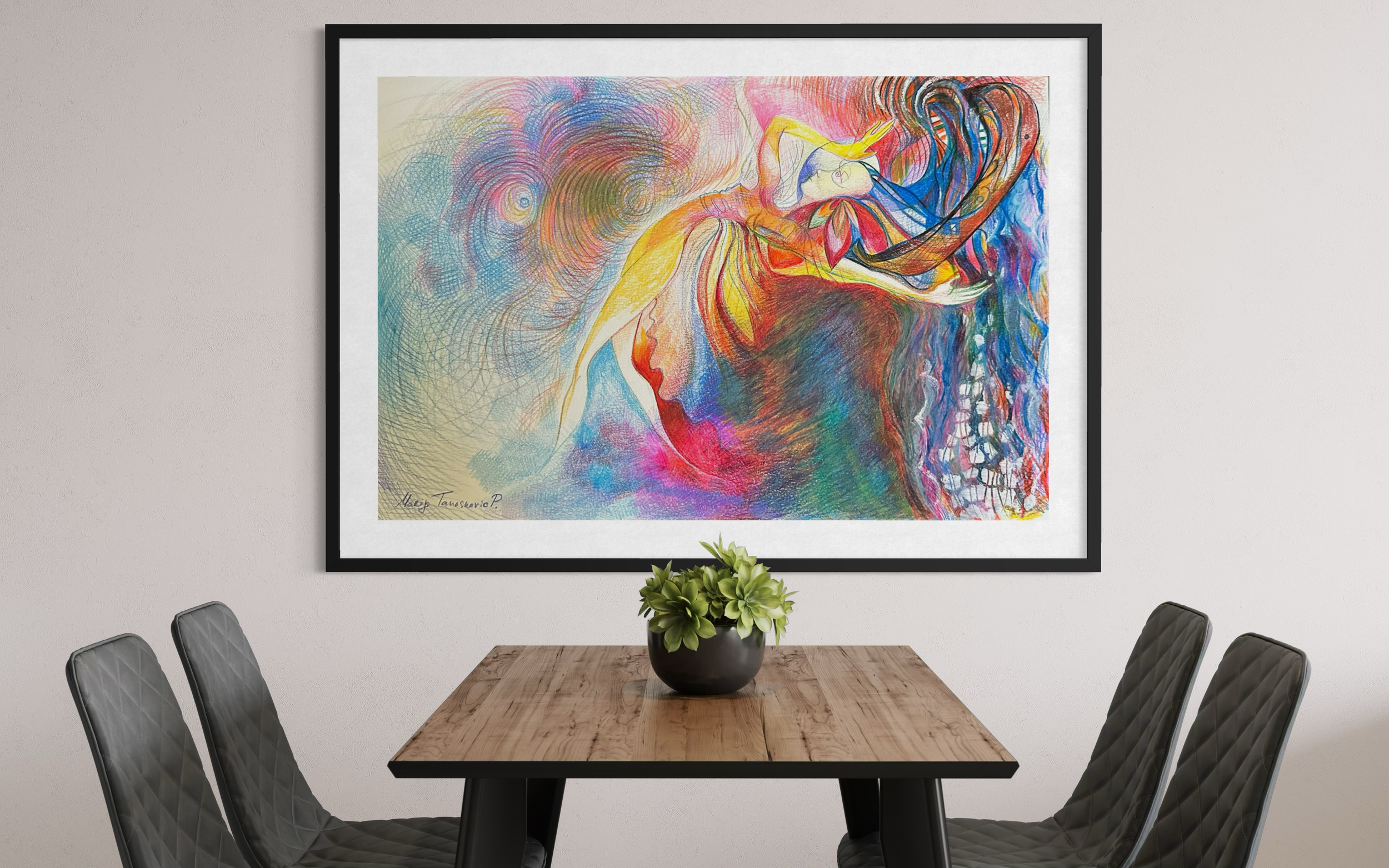
Her artistic statement embodies this philosophy: "Visual Art is fundamentally about transmitting energy to others through the symbols and vibrations of lines, color wavelengths, and the shapes of the artwork within its surrounding space. The meaning of the artwork transcends mere composition; it lies in the specific structure of the piece that enables a human being to perceive beauty as a source of harmony."

The theoretical basis extends to Wheeler’s delayed-choice experiment, illustrating how current decisions regarding measurements can retroactively influence a particle’s past behavior. In her artistic practice, this concept translates to the notion that an observer’s interaction with an artwork generates ripple effects that reach beyond the immediate experience of viewing. The artwork serves as a catalyst, while the observer brings the piece’s concepts into reality through their unique interpretation and emotional engagement.

This method empowers the audience to become co-creators instead of mere spectators. Her philosophy posits that observers collaborate with the artist to bring the artwork’s message into existence, akin to how ocean waves gradually sculpt coastal stones. She proposes that the electromagnetic waves generated by human thought patterns create vibrations that impact both quantum and macro levels of reality.

The practical ramifications of this theory highlight the significance of engaging with quality art. Given that thoughts directly affect decisions and shape personal realities, the kind of art one interacts with is vital. The vibrations generated through mental engagement with art carry information that influences life experiences in concrete ways.

Collectors and art lovers have shown great enthusiasm for both the philosophy and the artwork itself. The artist’s online gallery features original pieces and prints that consistently receive five-star ratings from customers, who commend the quality, detail, and color work in her compositions, as well as the professional handling of artwork delivery.

The intersection of quantum physics and visual art transcends mere intellectual exploration. It provides a framework for comprehending how art operates as more than just decoration or cultural artifact. In this perspective, artworks act as catalysts for consciousness, with each viewer’s observation playing a role in the continuous process of reality creation.

This groundbreaking approach challenges conventional boundaries between scientific exploration and artistic expression. By anchoring her creative philosophy in established physics experiments while preserving the mystery and beauty that are vital to art, Tanaskovic Papadopoulos has established a distinctive position in contemporary art discourse.

The intersection of quantum physics and visual art transcends mere intellectual exploration. It provides a framework for comprehending how art operates as more than just decoration or cultural artifact. In this perspective, artworks act as catalysts for consciousness, with each viewer’s observation playing a role in the continuous process of reality creation.

This groundbreaking approach challenges conventional boundaries between scientific exploration and artistic expression. By anchoring her creative philosophy in established physics experiments while preserving the mystery and beauty that are vital to art, Tanaskovic Papadopoulos has established a distinctive position in contemporary art discourse.